
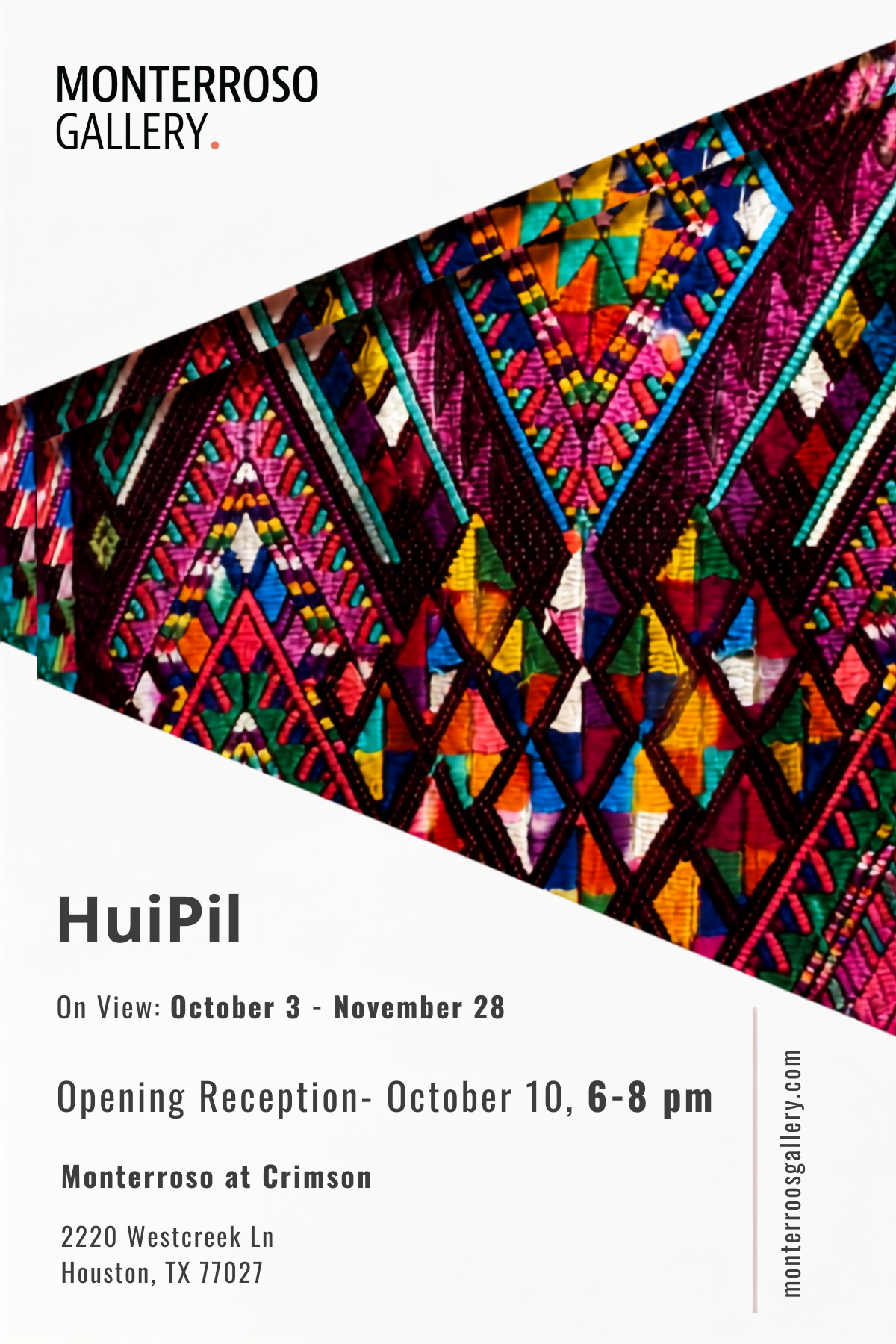
HUIPIL: Cuerpo y Memoria
October 10 - November 28, 2026
Presented during Hispanic Heritage Month, HUIPIL celebrates the work of Indigenous Guatemalan women through weaving passed from one generation to the next.
The exhibition is a collection that begun in 2001 by Monterroso Gallery founder Gabriela Monterroso and expanded over more than two decades. New huipiles continue to be discovered and acquired during her travels, including the Guatemala art tours organized by the gallery.
Each huipil in this room carries the mark of the town and of the individual weaver who made it. For centuries, women across Guatemala's highlands have hand-loomed these garments on the backstrap loom (telar de cintura), spinning and dyeing their own cotton before ever setting a design into the cloth.
For generations, the designs woven into huipiles carry symbols closely connected to specific communities and places. Sun rays often frame the neckline as the center of the garment's cosmos. Zigzags and triangles trace volcanoes. Diamonds mark the sun's path across the sky. Corn and milpa motifs honor the crop at the center of Maya life. Birds and flowers are associated with Santiago Atitlán, and mountains, animals, and geometric forms appear throughout the visual language of other highland communities, each pointing to the specific lake, forest, or highland the weaver called home.
Not every piece here was made in a single generation. Several show an older, hand-spun cotton base with a newer embroidered neckline added later, evidence that a huipil was mended, refreshed, or updated as styles and materials changed. Commercial threads (glossier rayon and synthetic threads, often called sedalina or "hilo alemán" in the market; the name describes the type of thread, not necessarily its country of origin) and glass beadwork entered this tradition over the twentieth century, layering new materials onto forms that are centuries old.
Today, younger generations of weavers are creating new designs, still inspired by the places they inhabit. The materials are changing too. Traditional hand-spun and naturally dyed fibers now exist alongside commercially produced threads, embroidery, mostacilla, and other materials. The huipil continues to change because the women making it continue to create.
You'll also notice that none of these huipiles are finished along the bottom hem. That is part of the construction. A huipil is worn tucked into the corte (skirt) and cinched with a faja (sash), so the hem is never seen and was never meant to be finished.
Monterroso's ceramic sculptures of women are included to honor the women behind this art: the women who weave, embroider, make, wear, teach, and continue to reinvent the huipil.