
This exhibition marks the first solo presentation to emerge from our one-year Monterroso Gallery Residency Program — a program built around sustained critique, professional development and dialogue, all working toward a public exhibition.
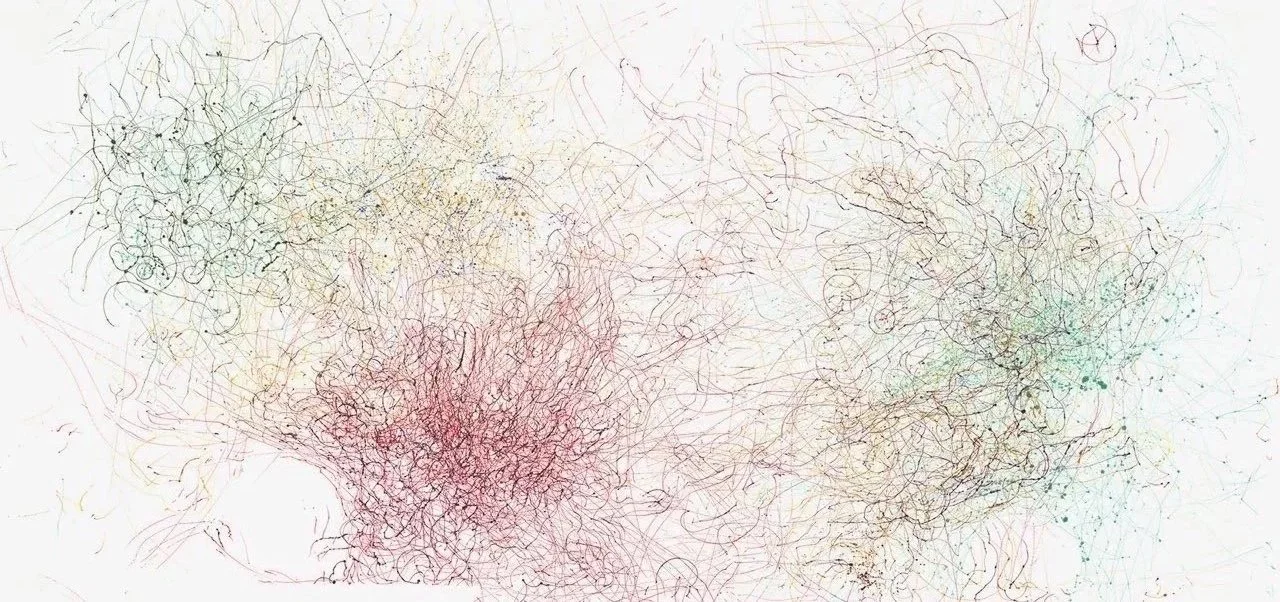
Over 84 consecutive hours, wind moved a live oak tree fitted with strings and ink pens, producing a monumental drawing generated by natural forces. The exhibition also includes photographs documenting the process and conditions of that day — tracing the collaboration between artist, wind, time, and chance.
Holly Josey: The Day the Wind Drew
March 7, 2025 - April 19, 2026
Curator’s Statement
There are two questions underneath all of these works — what does it mean to let go? And what does nature already know? Holly Josey answers these questions with open hands.
Holly Josey’s exhibition The Day the Wind Drew began with a simple act: pens suspended from tree branches, left to move however the wind moved them. Over hours and days, the marks accumulated — not chosen, not corrected, just received. The original work is intimate — 84 inches, on paper — but the wind is not intimate. It is vast. So, the wind’s drawing was photographed and printed at monumental scale, filling a 10.5 by 18-foot wall. What remains is a kind of frozen breath, a single moment pulled from an endless series of compositions.
As a curator who works as both an eco-artist and a citizen scientist, I am drawn to what is happening in this work on a deeper level. We are living in a moment when it is dawning on us — slowly, and not without resistance — that the natural world’s intelligence has been unfolding since long before we arrived. The wind has its own logic. The tree has its own memory. Natural systems have been perceiving, connecting, and evolving for far longer than we have. To make art with them, rather than simply from or of them, feels urgent right now. It feels necessary.
It calls to mind something Marcel Duchamp understood a long time ago — that an artist does not have to be the one holding the brush at the final stroke. When his large glass work was damaged in transit, shattering into a web of cracks, Duchamp did not mourn it. He called it finally finished. The accident had completed it. Earlier still, he had let threads fall from a height and fixed their landing exactly as they landed — chance crystallized into form. He was making room for the world to collaborate.
Josey does the same, only her collaborators are alive. The tree. The wind. Time itself. These are not abstractions — they are presences in the room with you as you look. The erratic lines on her paper are evidence of a relationship, a conversation carried on without words between the viewer and the elements. This is what any artist or citizen scientist recognizes: that watching carefully, without forcing a conclusion, is itself a form of knowledge. That the most beautiful things happen at the fringes, in the borders, in the unexpected moments when you let go.
This is what connects everything in this exhibition. Not a style, not a medium, but a willingness to not know exactly what will happen — and to begin anyway. To stay open to risk. To let the work breathe. To learn, as natural systems have always learned, by paying close attention to what the world is already doing.
Cindee Travis Klement
www.cindeeklement.com